BECC 133 : Principles of Macroeconomics-I in English Solved Assignment 2025-2026
Title : BECC 133 : Principles of Macroeconomics-I Solved Assignment 2025-2026
Course Title : Principles of Macroeconomics-I
Course Code : BECC 133
Assignment Code : ASST/TMA/2025-2026
Maximum Marks : 100
Title : BECC 133 : Principles of Microeconomics-I in English Solved Assignment 2025-26
Course : CBCS/BCOM
University : IGNOU
Service Type : Soft Copy (Solved Assignments)
Language : English
Product : Solved Assignment of BECC 133 (IGNOU)
Short Name : BECC 133
Why Choose IGNOU Scholars for Assignments?
- Expert Guidance
IGNOU Scholars often provide expert support with a deep understanding of IGNOU’s syllabus and assignment format. Accurate Solutions
Their assignments are usually well-researched, accurate, and aligned with the university’s requirements.Time-Saving
Preparing assignments from scratch can be time-consuming. IGNOU Scholars help save time by offering ready-to-use or well-structured drafts.Customized Work
Many IGNOU Scholars offer personalized assignments based on your course, subject, and preferences.High-Quality Content
Assignments provided are generally plagiarism-free, well-organized, and written in simple yet effective language.
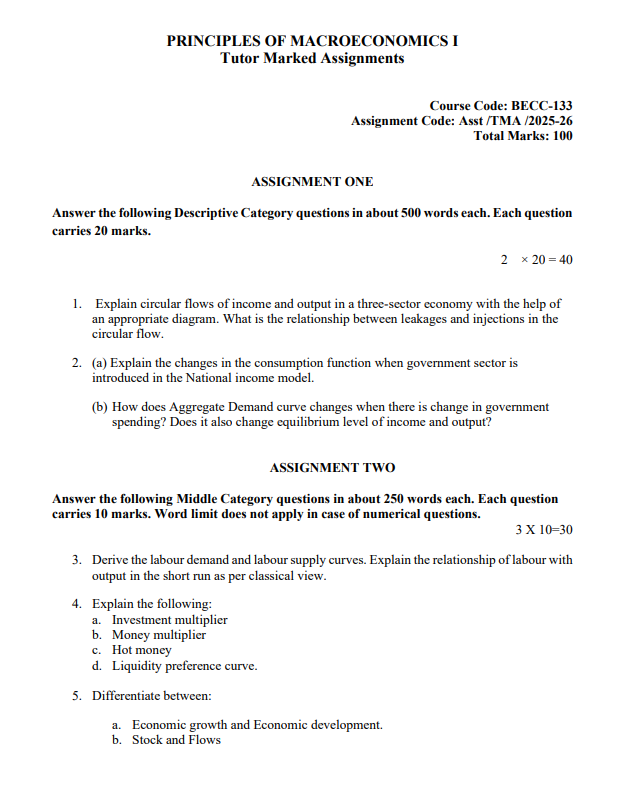
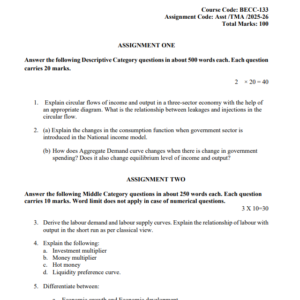
ASSIGNMENT ONE
Answer the following Descriptive Category questions in about 500 words each. Each question carries 20 marks.
1. Explain circular flows of income and output in a three-sector economy with the help of an appropriate diagram. What is the relationship between leakages and injections in the circular flow.
2. (a) Explain the changes in the consumption function when government sector is introduced in the National income model.
(b) How does Aggregate Demand curve changes when there is change in government spending? Does it also change equilibrium level of income and output?
ASSIGNMENT TWO
Answer the following Middle Category questions in about 250 words each. Each question carries 10 marks. Word limit does not apply in case of numerical questions.
3. Derive the labour demand and labour supply curves. Explain the relationship of labour with output in the short run as per classical view.
4. Explain the following:
a. Investment multiplier
b. Money multiplier
c. Hot money
d. Liquidity preference curve.
5. Differentiate between:
a. Economic growth and Economic development.
b. Stock and Flows
ASSIGNMENT THREE
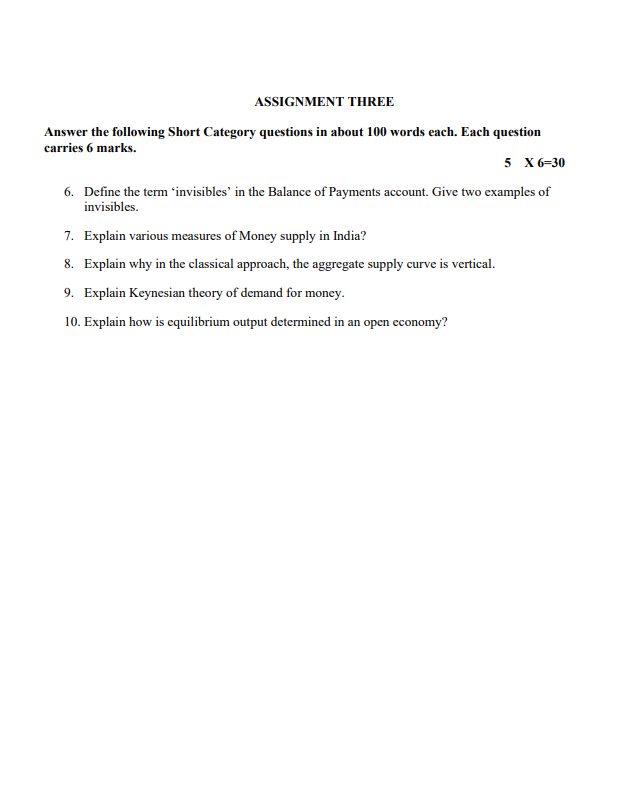
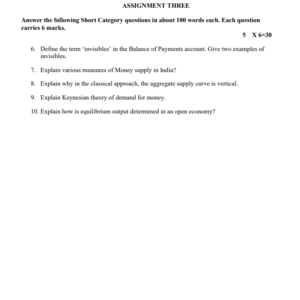
Answer the following Short Category questions in about 100 words each. Each question carries 6 marks.
6. Define the term ‘invisibles’ in the Balance of Payments account. Give two examples of invisibles.
7. Explain various measures of Money supply in India?
8. Explain why in the classical approach, the aggregate supply curve is vertical.
9. Explain Keynesian theory of demand for money.
10. Explain how is equilibrium output determined in an open economy?